
Cooked meat, raw seafood, and protein snacks lose texture fast in hot air. Heat tightens muscle fibers, so the finished product turns chewy and hard to rehydrate. A commercial meat freeze dryer removes water below the freezing point instead, and that single difference protects structure. Hadof builds these lines around your protein type, batch weight, and daily output.
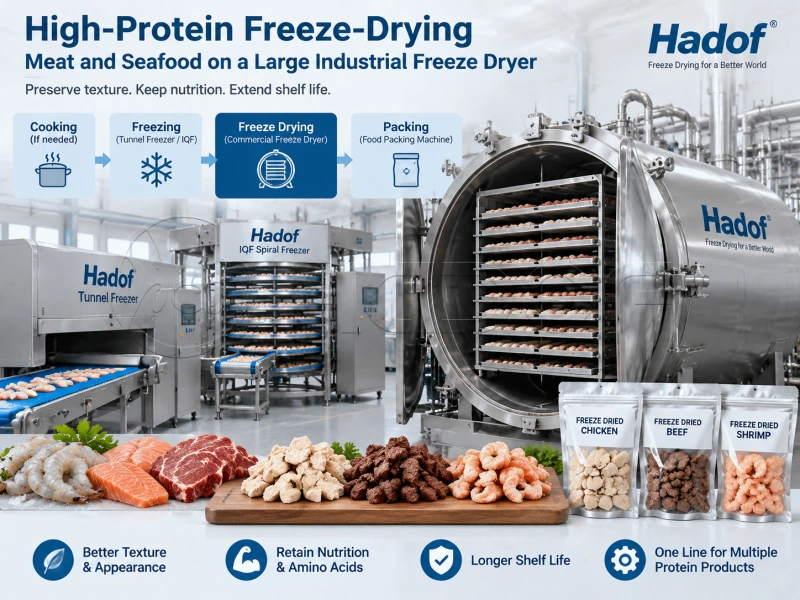
High-Protein Freeze-Drying Meat and Seafood on a Large Industrial Freeze Dryer
Which Protein Products Fit This Freeze-Drying Line?
Many protein types suit this process, so one line can cover several products. Cooked chicken, beef strips, and pork cubes dry well after a short cooking step. Raw shrimp, scallops, and fish fillets freeze fast because they hold less connective tissue. What’s more, pet treats and protein snacks share the same chamber through food-grade programs. Each product changes slice size, tray depth, and cycle length, yet the same equipment handles all of them. Marinated or pre-cooked items need a shorter blanch, because sugar and salt speed ice formation.
Why Does Protein Need Low-Temperature Drying?
Moisture leaves meat through thousands of tiny channels, so the drying method decides the final bite. High heat drives water out quickly, yet it also cooks the surface a second time. Therefore, proteins shrink, darken, and lose their natural aroma. Freeze drying turns ice straight into vapor instead, so fibers keep their shape and volume. Besides, that gentle path protects amino acids and heat-sensitive vitamins. Such a commercial meat freeze dryer also keeps fat from oxidizing during a long cycle. That low-temperature path also keeps cooked flavor notes intact.
How Does a Commercial Meat Freeze Dryer Handle Heavy Loads?
Cooked protein holds more water than most vegetables, so batch weight climbs fast on a large chamber. A commercial meat freeze drying equipment set spreads that weight across 17 shelf layers. Shelf temperature stays within ±1 °C, so every tray dries at the same rate. Meanwhile, the condenser pulls 1000 kg of water per batch on a 50 m² unit. Heavy loads therefore finish without a second pass. Tray weight ratings matter as well, because protein loads run heavier than produce.
Which Freezing Step Protects Protein Texture?
Freezing speed decides whether protein keeps its bite after drying. A fast freeze forms small ice crystals, so muscle fibers stay intact through the vacuum stage. An industrial tunnel freezing machine moves loaded trolleys through a cold tunnel on a fixed schedule. For diced or portioned product, an IQF spiral freezing machine freezes each piece separately. Because both routes freeze quickly, texture survives the whole cycle. Slow freezing instead grows large crystals, and those crystals tear fibers apart. Tunnel freezing also matches tray handling, so protein keeps one depth from freezer to shelf.
What Parameters Decide Protein Cycle Time?
Parameter choice decides cycle length, energy cost, and product consistency across every batch. Check these values before you compare suppliers.
| Parameter | Typical Value |
| Ultimate vacuum | ≤5 Pa |
| Shelf temperature uniformity | ±1 °C |
| Condenser temperature | -40 °C or -60 °C, dual compressor for deep freeze |
| Water catch capacity | 1000 kg/batch on a 50 m² unit, 2000 kg/batch on 100 m² |
| Chamber material | SUS304 food-grade stainless steel |
| Refrigerant | R507A |
| Power supply | 380 V, 3 phase, 50 Hz |
| Defrost method | Spray water defrost |
Shelf spacing of 70 mm also keeps airflow steady between loaded trays. And defrost handling between cycles protects daily uptime.
How Do You Pack High-Protein Product Without Losing Quality?
Protein absorbs moisture quickly, so packing speed decides shelf life. Then a food packing machine fills and seals each bag within moments of sorting. Nitrogen flushing or vacuum sealing blocks vapor during long sea transit. Seal testing confirms barrier quality before cases leave the plant. Sorted loads also let the packager run at a constant speed.
Build the High-Protein Freeze-Drying Line as One System
Every step in this line either protects the protein or spends it, so one design should cover the whole chain. Then cooking, freezing, drying, and packing run to a single rhythm. For a customized solution, visit the Hadof freeze dryer homepage at https://www.freezehadof.com/.