
The tire pyrolysis industry has experienced rapid growth in recent years as more companies seek sustainable ways to recycle waste tires. While pyrolysis oil often receives the most attention, recovered carbon black (rCB) has become an increasingly valuable by-product that can significantly improve a plant’s profitability. However, selling carbon black in powder form presents challenges related to dust, storage, transportation, and customer acceptance. As a result, more tire recycling companies are investing in carbon black pelletizing equipment to upgrade their products and create additional revenue streams.
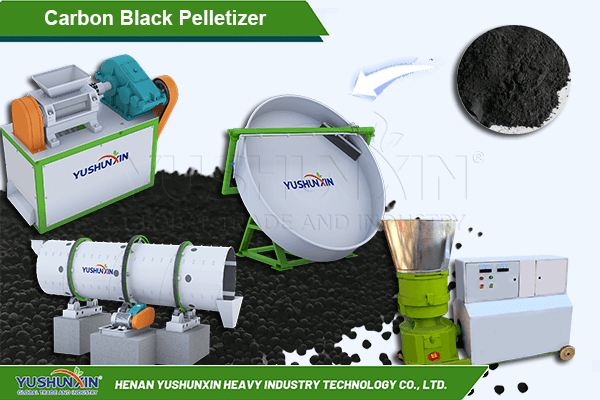
Carbon black pelletizer for sale
The Challenges of Selling Carbon Black Powder
Recovered carbon black generated by tire pyrolysis plants is typically collected as a fine powder. Although it contains valuable carbon content, handling powdered materials can be difficult. Dust emissions during loading and unloading may create environmental concerns, while the low bulk density increases transportation and storage costs.
In addition, many downstream users prefer granulated products because they are easier to handle during production. For this reason, tire pyrolysis operators are searching for efficient ways to convert powder into uniform granules that meet market requirements.
Why Pelletized Carbon Black Has Higher Market Value
Pelletized carbon black offers several advantages compared with loose powder. Granules generate less dust, improve flowability, and reduce material loss during transportation. These benefits allow buyers in the rubber, plastic, and construction industries to use the material more efficiently.
A modern carbon black granulator can transform fine powder into dense and uniform pellets, making the product more attractive to industrial customers. As a result, pelletized rCB often commands higher selling prices and expands the potential customer base.
Building a Complete Granulation System
To achieve consistent product quality, many plants choose a complete recovered carbon black granulation line rather than a single machine. A typical system includes feeding equipment, grinding units, granulators, dryers, coolers, screening machines, and packaging equipment. learn more.
This integrated approach ensures stable operation and allows manufacturers to produce granules with controlled size, moisture content, and strength. By improving product consistency, producers can meet the quality expectations of larger industrial buyers.
Large-Scale Production Creates Better Returns
As demand for pelletized rCB continues to rise, many recycling companies are expanding their processing capacity. A 10 tph carbon black pelletizing system enables large-scale continuous production while reducing labor costs per ton. Higher throughput also allows companies to process more recovered carbon black and maximize the value of their pyrolysis operations.
For growing businesses, investing in industrial-scale pelletizing equipment often delivers a faster return on investment than relying solely on raw powder sales.
Successful Projects Are Driving Industry Confidence
Around the world, more companies are seeing the economic benefits of upgrading recovered carbon black. For example, a recovered carbon black pelletizing project in Indonesia demonstrated how pellet production can improve product quality and increase market competitiveness. Such projects provide practical examples for other tire recycling businesses considering similar investments.
A Strategic Upgrade for the Future
As competition in the tire recycling industry increases, companies must find ways to generate greater value from every output stream. Implementing a carbon black pelletiizing solution for pyrolysis plant operations is becoming one of the most effective strategies for improving profitability. By converting low-density powder into high-value granules, pyrolysis plants can access new markets, increase product prices, and strengthen their long-term business performance. If you are interested in the project, you can visit https://www.fertilizerbusinessplan.com/carbon-black-pelletizer/