
Bare spots on shrimp, onion rings, mushrooms, and sliced vegetables are rarely caused by one problem alone. An industrial tempura batter line for shrimp and vegetables must coordinate raw-material preparation, surface-moisture control, batter mixing, viscosity, immersion, conveying, excess-batter removal, and fryer entry. If one stage is unstable, exposed areas may remain visible after frying even when the batter recipe appears correct.
What Do Bare Spots Reveal About the Process?
A bare spot is an area where the batter fails to wet the product, drains away before frying, or separates during fryer entry. The location of the defect can help identify its cause.
Bare areas on the upper surface may indicate incomplete immersion or floating products. Defects around edges and corners may result from weak batter adhesion, abrupt conveyor transfers, or excessive air-knife pressure. Random pinholes may be associated with surface water, air bubbles, foam, or inconsistent batter mixing.
The product should therefore be inspected immediately after battering, during transfer, at fryer entry, and after frying. Waiting until final packing makes it difficult to determine where the coating was lost.
Control the Raw Material Before Battering
Shrimp and vegetables should enter the coating section with repeatable surface conditions. Excess water can dilute the batter at the product interface, while ice crystals or frost on frozen ingredients may melt and interfere with adhesion.
Processors should control:
- Product temperature
- Surface water after washing or thawing
- Size and thickness variation
- Broken or folded pieces
- Flour, starch, or predust coverage
- Time between preparation and battering
Shrimp with very wet surfaces may need controlled draining before coating. Sliced vegetables should be checked for free water released after washing or cutting. If predusting is used, its coverage should be thin and consistent rather than clumped.
These controls should match the intended product style. Traditional tempura preparation and batter characteristics can provide useful culinary context, but an industrial factory also needs measurable specifications for temperature, viscosity, residence time, and line speed.
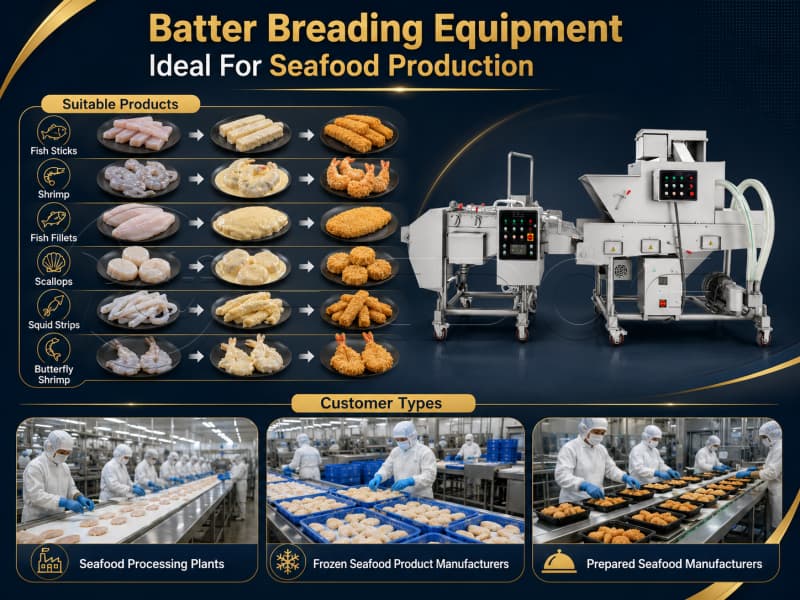
Batter Breading Equipment Ideal for Seafood Production
Keep Batter Preparation Consistent
Batter condition changes during production. Flour and starch hydrate over time, temperature rises, solids settle, and product moisture enters the recirculating mixture. Therefore, the starting recipe alone does not guarantee stable coating.
A production specification should define:
- Ingredient sequence
- Mixing time and speed
- Batter temperature range
- Viscosity measurement method
- Acceptable viscosity range
- Resting or holding time
- Frequency of checks
- Rules for replenishing batter
- Conditions requiring a fresh batch
Operators should use the same measurement method throughout the shift. A reading taken with different tools, temperatures, or sampling locations may not be comparable.
The batter tank also requires controlled circulation. Insufficient movement can allow solids to settle, while overly aggressive pumping can introduce foam or change the mixture structure. Filters and screens should be checked for accumulated particles that may disturb flow.
Choose the Correct Battering Method
A thin, free-flowing slurry and a thick tempura batter do not behave the same way. Waterfall systems apply an upper curtain while the lower portion of the product contacts batter in the tank. This arrangement can suit fluid coatings when curtain height, flow, and product spacing are properly controlled.
Lightweight shrimp, vegetables, and irregular products may float or rotate before every surface is coated. For these products, an automatic submerging batter applicator for tempura products can use upper and lower belts to hold the food beneath the batter surface. Full immersion helps the batter reach the top, bottom, edges, and recessed areas.
The choice should be based on trials with the buyer’s actual product. Product density, shape, thickness, temperature, and batter viscosity all influence whether waterfall or submerging application is more suitable.
Adjust Immersion and Conveyor Conditions
Even the right machine can produce bare spots if it is set incorrectly. The product needs sufficient contact time with the batter, but excessive residence time may create an unnecessarily heavy coating.
Check the following variables:
- Infeed spacing
- Belt speed
- Batter depth
- Upper-belt position
- Product orientation
- Immersion time
- Transfer height between conveyors
- Distance from battering to frying
Products should enter in a single, controlled layer. Overlapping shrimp or vegetable pieces prevent the batter from reaching contact surfaces. Very close spacing may also disturb the batter flow and cause neighboring pieces to touch before the coating sets.
At discharge, the transfer should be smooth. Long drops, narrow transfer gaps, and abrupt direction changes can scrape or shake batter from fragile products.
Control Excess-Batter Removal Carefully
Some batter must drain before frying, but removing too much can expose edges and corners. Air knives, vibration, or draining time should be adjusted to achieve the target pickup without stripping the surface.
When bare spots consistently appear on the same side of a product, inspect air direction and pressure. When coating disappears from the leading or trailing edge, inspect belt transitions and draining time. If the defect becomes worse later in the shift, examine batter temperature, viscosity, solids content, and foam accumulation.
Processors should record coating pickup by comparing product weight before and after battering. The factory can then connect visual appearance with a measurable pickup range rather than relying entirely on operator judgment.
Stabilize the Transfer Into the Fryer
A well-coated product can still lose batter at fryer entry. A high drop into the oil, strong oil turbulence, contact with another product, or an unsuitable belt transition can separate the wet coating before it sets.
The battering machine and fryer should therefore be treated as one connected system. A suitable continuous frying process for coated seafood and vegetables coordinates feeding, belt movement, oil conditions, filtration, and downstream draining.
During commissioning, observe the first seconds after the product contacts the oil. The coating should set without folding, washing away, or bonding adjacent pieces together. Adjustments may involve transfer height, belt speed, product spacing, fryer entry position, or batter condition.
Use a Structured Trial Instead of Random Adjustments
Changing several settings at once makes troubleshooting difficult. A controlled trial should hold most variables constant and change one factor at a time.
A practical test sequence can include:
- Confirm product temperature and surface condition.
- Prepare batter using the approved mixing procedure.
- Record batter temperature and viscosity.
- Set one conveyor speed and immersion depth.
- Process a defined sample quantity.
- Measure coating pickup.
- Photograph defects before and after frying.
- Change only one parameter for the next sample.
- Record the result and select the most stable operating window.
Trials should include the smallest, largest, lightest, and most irregular products expected in normal production. A setting that works for uniform vegetable slices may not work for curved shrimp or lightweight mushroom pieces.
What Should Buyers Send to the Equipment Supplier?
Before requesting a line proposal, prepare:
- Product names and photographs
- Fresh, chilled, or frozen condition
- Product dimensions and unit weight
- Expected hourly capacity
- Batter recipe type
- Available viscosity data
- Target coating pickup
- Current bare-spot photographs
- Predusting or breading requirements
- Fryer type and belt width
- Workshop dimensions
- Local voltage and utilities
A supplier should use this information to recommend the battering method, belt width, capacity, transfer arrangement, and connected frying equipment. Buyers can review a fried food production equipment supplier when planning a combined batter mixing, coating, frying, draining, freezing, or packaging system.
Final Troubleshooting Checklist
Before changing the recipe, confirm that the product is properly drained, separated, and presented to the battering machine. Then verify batter temperature, viscosity, mixing, circulation, and replenishment. Inspect immersion depth, belt position, product spacing, excess-batter removal, conveyor transfers, and fryer entry.
The most effective solution is usually a stable process window in which the raw material, batter, applicator, and fryer operate as one continuous system. Documenting those settings allows food factories, seafood processors, central kitchens, frozen-food manufacturers, and equipment buyers to reproduce the same coating quality across production shifts. You can visit: https://www.friedfoodsolutions.com/automatic-batter-breading-machine/