
When you plan a fertilizer granulation project, capacity is only one part of the decision. Your raw material, product formula, moisture, available space, automation level, and final package size can all change the equipment combination. A practical fertilizer granulation plant design begins with your production goal and then connects each process step around that target.
Start with Your Target Capacity
A 1–3 T/H line often suits a smaller factory, a new market, or a project with limited raw material supply. If your expected sales volume is higher, a 5–10 T/H line can give you more room for continuous operation and future growth. For larger industrial projects, 15–20 T/H capacity usually involves larger batching, granulation, drying, cooling, screening, conveying, and packing sections.
Fertilizer production line capacity selection becomes easier when you compare hourly output with annual operating days, daily shifts, raw material availability, and your realistic sales plan. This helps you avoid choosing equipment that is either underused or too small for your market.
Match the Granulation Route to Your Formula
If you produce compound fertilizer from urea, ammonium phosphate, potassium salts, and other mineral materials, an NPK fertilizer granulation plant can be arranged around batching accuracy, granulation stability, drying, cooling, screening, and recycle material handling. Different formulas may also influence how much binder, water, or steam enters the process.
For projects with relatively high throughput, a rotary drum fertilizer granulation plant can provide continuous processing and a layout that connects well with dryers, coolers, screens, coating machines, and automatic packing systems. You can also reserve space for future storage bins or a second packing line.
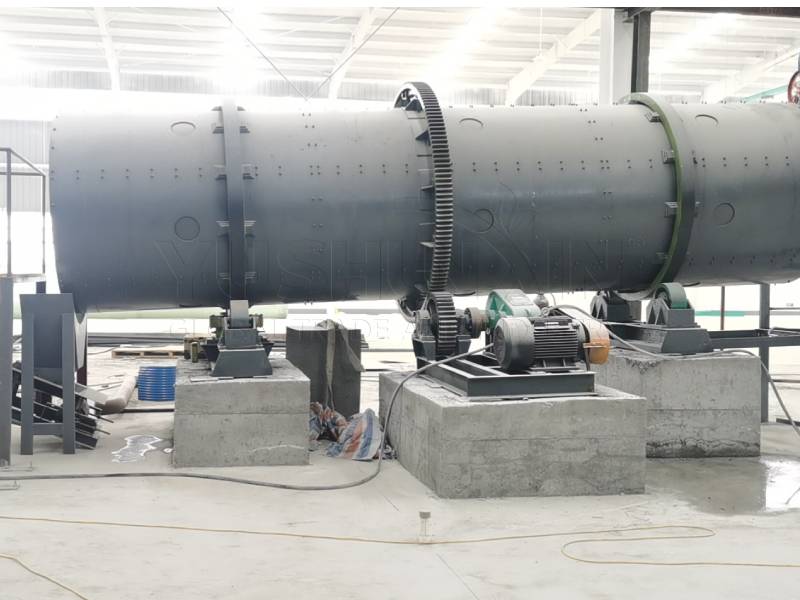
10-20 th fertilizer rotary drum granulator
Consider Raw Material Condition Before Equipment Size
The same hourly capacity can require different equipment if your feedstock behaves differently. Powder fineness, moisture, bulk density, and particle uniformity can affect feeding, mixing, granulation, and screening. If the material arrives with large lumps or unstable moisture, pre-treatment may take more space and power than you first expect.
You can therefore evaluate the full material flow rather than comparing only the granulator model. This gives you a clearer view of conveyor size, buffer storage, return material ratio, and workshop arrangement.
Plan Space, Automation, and Expansion Together
A compact 1 T/H project may use manual or semi-automatic feeding and packing, while a 20 T/H line often benefits from centralized controls, continuous weighing, automatic batching, and more coordinated conveying. You can leave maintenance aisles, inspection points, and expansion areas in the layout so later upgrades are easier to manage.
If your raw material is composted manure, agricultural waste, or other organic feedstock, an organic fertilizer granulation plant can follow a different process route from mineral NPK production, especially in crushing, moisture adjustment, granulation, drying, and odor or dust handling. Click here for more details.
Build the Plant Around Your Real Project
Before requesting a proposal, you can prepare your target capacity, raw material list, formula, moisture, granule size, package size, annual operating schedule, workshop dimensions, and preferred automation level. With these details, the supplier can configure the line around your actual production conditions instead of offering a generic capacity package. If you are interested in a fertilizer granulation plant, you can visit:https://www.shunxin.eu/fertilizer-granulation-plant/