
bA granulator can meet its nominal output and still perform poorly in an unsuitable line. Feed moisture, compost preparation, pellet specification and downstream capacity all influence the result. When comparing a compost granulator for mature compost, evaluate the complete production route instead of machine price alone.
Is Your Compost Ready for Granulation?
Stable feeding begins with fine, uniform compost. The target page places feeding, crushing, screening, batching and mixing before granulation. These stages remove large lumps, control flow and create a more consistent mixture.
Granulation converts powder or fine particles into larger granules. For compost containing about 20%–40% moisture, wet compost granulation equipment can use liquid cohesion and mechanical motion. For feed below 15% moisture, a dry compost pelletizing machine can form pellets through compression without adding granulation water.
Which Machine Matches Your Required Output?
The target page presents several operating ranges:
- Rotary drum granulator: 1–30 t/h and 3–6 mm pellets
- Disc granulator: 1–6 t/h and 1–8 mm pellets
- New-type granulator: 1–8 t/h and 2–5 mm pellets
- Double-roller granulator: 1–4 t/h and 3–10 mm pellets
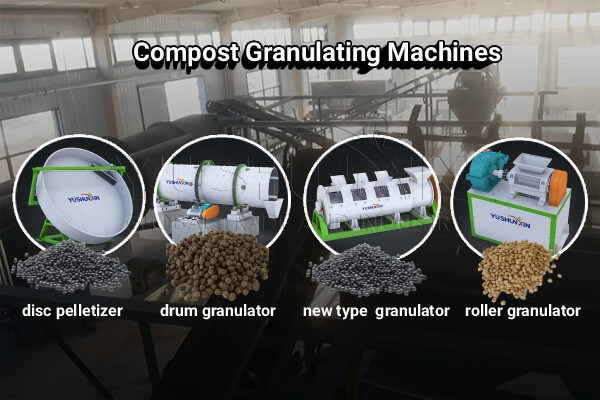
Compost granulating machines for sale
A practical compost granulator capacity selection also considers the feeder, crusher, mixer and screener. If one section runs below the planned rate, it limits the whole line. Drying, cooling and packaging capacity also need to follow the expected finished-pellet output.
What Pellet Standard Does Your Market Need?
The required shape, diameter and strength help separate the available routes. Drum equipment suits higher continuous output, while a disc provides broad size adjustment. A new-type granulator adds stronger mechanical action, and roller extrusion fits drier feed.
If the raw material already has wet-granulation moisture, compare a wet granulation machine for compost before adding drying equipment or selecting a dry press. For reliable industrial compost pellet production, define the acceptable fines, oversize return and final bag specification as part of the equipment plan.
What Information Improves the Quotation?
Provide the supplier with:
- Compost source, moisture and particle size
- Required hourly output and operating hours
- Target pellet diameter, shape and strength
- Existing upstream and downstream equipment
- Workshop dimensions, voltage and bag size
These details make quotations easier to compare and help engineers match each process section. You can view the complete machine range and request a layout based on your actual compost:
https://www.granulatedcompostsolutions.com/product/compost-granulating-machine/