
Understanding Industrial Composting Needs
When setting up an organic fertilizer or waste recycling facility, choosing a suitable industrial composting machine is one of the most crucial decisions. The machine not only affects composting speed and uniformity but also determines site design, energy consumption, and labor costs. Since every project differs in feedstock composition, moisture content, and scale, there is no “one-size-fits-all” compost turner.
1. Evaluate Raw Materials and Moisture Content
Different raw materials—such as animal manure, crop residues, or food waste—require distinct composting approaches. For example, cow manure and straw mixtures need a turner capable of handling fibrous and bulky materials, while biogas residues or sludge demand enclosed or groove-type composting to control odor and leachate.
If your material moisture exceeds 60%, machines with aeration systems or forced ventilation are preferable to maintain oxygen levels and prevent anaerobic zones.
2. Consider the Scale and Site Layout
Your plant capacity directly influences the choice of commercial composting equipment.
-
Small-scale farms (below 500 m³ compost per batch) often choose moving-type compost turners, which are flexible and easy to operate.
-
Medium to large-scale facilities prefer groove-type or wheel-type compost turners, which can process thousands of cubic meters of material in continuous operation.
-
For industrial-scale organic fertilizer plants, a fully automatic composting system with centralized control and temperature sensors ensures consistent fermentation quality.
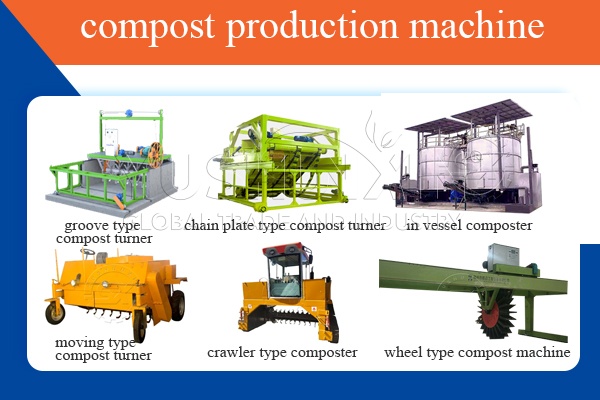
industrial composting systems for sale in YUSHUNXIN
3. Check Energy Efficiency and Operation Costs
Energy consumption and maintenance directly affect operating budgets. Hydraulic compost turners provide strong turning power for dense materials but consume more energy, while crawler-type composting machines balance efficiency and mobility.
Some modern systems include frequency converters to optimize turning speed, reducing power usage by 10–20% without compromising compost quality. Learn more!
4. Automation, Monitoring, and Safety
Today’s industrial composting systems often integrate automatic temperature monitoring, aeration adjustment, and remote control. Automation helps reduce manual labor and maintain optimal microbial activity. Safety features—such as emergency stop systems and overload protection—are equally important for continuous and secure operation.
5. Partnering with a Reliable Manufacturer
A dependable supplier can customize your organic waste compost machine based on feedstock type, available space, and expected throughput. For instance, YUSHUNXIN provides various compost turners—groove, wheel, crawler, and moving types—that fit different project scales. Engineering support and layout design ensure smooth installation and efficient fermentation performance.
Conclusion
Choosing the right industrial compost turner depends on understanding your raw materials, composting capacity, and automation preferences. With the proper commercial composting equipment, you can achieve faster decomposition, stable product quality, and sustainable waste management for long-term fertilizer production.Welcome to visit: https://www.fertilizerequipmentprice.com/industrial-composting-machine/